What kind of lamp photosynthesizes with plants?
Leave a message
1.LED
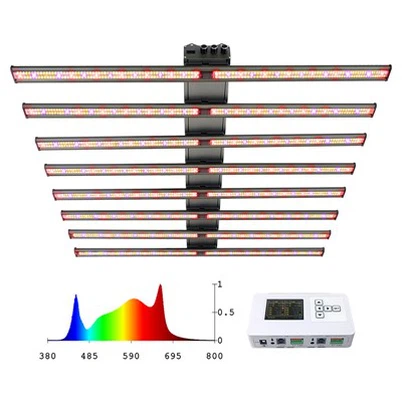
This saves electricity, emits little waste heat, and has a long life. LED planting is absolutely possible, but I do not recommend LED for family raising. Although LED can be full spectrum, but the full spectrum of beads distribution is not uniform, if a small area of close irradiation, for small plants, the spectral distribution is not balanced. And I have yet to find an LED with UVB. LED is more power-saving, the uneven distribution of lamp beads can be solved with large-scale, long-distance, but in general, full-spectrum LED is more suitable for greenhouse and factory planting. At the same time, the lack of UVB is also more suitable for C3 and C4 plants. If you increase the UVB lamp beads alone, a large area of high intensity, it is OK. But in general, it's not very efficient in small quantities. If the annual plant, regardless of root development, regardless of shape, red and blue is enough, if considering root development needs to add orange and yellow light, orange and yellow light also has a certain underground accumulation.
2. Three primary colors
The heat is not too much, cheap, the spectral distribution is not very reasonable, the energy consumption is relatively large, and the utilization rate of plant utilization is below 70%. The disadvantage of using three primary colors is that the energy consumption is still a bit large, and the light intensity of no 10000LX can be said to have no effect on desert plants. But the energy required for 10000LX is quite scary, and I have calculated that it is about 500 watts per square meter (50CM distance), which is not cost-effective for long-term use.
3. Little Sun
As the name suggests, it is a small sun, fully imitating the sun's illumination, and even heating. If it's enough, if it's bright enough, it's the same as sunlight. But the energy consumption is horrendous in "sufficient" quantities, and those South African plants we love, don't like too much heat. This is absolutely useless, it works well for tropical water plants, or if you plan to grow lotus flowers out of season, it is fine, but the energy consumption is too amazing, discard it.
4. Rare Earth lamp
The main active component is copper selenium powder, resulting in a specific spectrum, blue and pink two. Aquarium lamps are also this, and the three primary colors are the same as fluorescent lamps. The spectral accuracy is higher than the three primary colors and less than the LED, which means that the energy consumption is higher than the LED to achieve the same effect, and the life is shorter than the LED. But his advantage is that the light is very uniform and the spectral continuity is strong. This uniform light is more suitable if we do not need too much illumination area. Now I mainly use this kind, the blue has a certain amount of UVA and negligible UVB, which is more suitable for UVB lamp. Germany and the United States began producing such lamps several years ago for use in aquatic plants. It is now produced domestically. 200W per square meter is basically enough for desert plants, and if it is for plateau plants, it can be appropriately increased. Don't too much, will be tragic ~! Now meat friends use blue lights, I must say, using blue lights alone will be a little abnormal plant status, if it is no problem as a semi-sunshine fill light, if the daytime average is less than 2000LX environment must add red light.
Third, about the use of different types of lights to cope with different planting environments
1. As the most common is that there is sunlight but across the glass, then you only need UVB, I must say, UVB10.0 can not reach the intensity of the origin, but at the same time, our total light intensity can not reach the origin, combined with water control can be very good. Just grow slower.
2. Semi-sunshine, not separated from the glass, then you need to increase the intensity of the full spectrum, red and blue +UVB+UVA, or rare earth lamp +UVB, to make up for half a day without direct sunlight
3. There is no light at all, or long-term rain, you need high power, full spectrum, indoor scattered light red light can be a small amount of UVA, low wavelength light needs to be strong, flower can add red light ratio, but too strong flowers will prematurely decay.