Comparing Solar Lights For Residential And Commercial Use In 2025
Leave a message

Solar light is essential in advancing energy efficiency and sustainability in 2025. The use of solar light is growing rapidly as homeowners and businesses prioritize eco-friendly lighting solutions. With advancements in solar technology, these products have become more efficient and cost-effective. Websites such as solarlightmeeting.com offer valuable insights into various options, including solar garden light designs, to cater to a wide range of needs.
Key Takeaways
Solar lights are good for the environment and save money. They help lower electricity and repair costs over time.
Picking strong solar lights with good panels and tough materials makes them last longer and work better.
Home and business solar lights are made for different uses. Home lights look nice, while business lights are strong and work well.
Understanding Solar Light Technology
How Solar Lights Work
Solar lights operate based on the photovoltaic effect, a process that converts sunlight into electricity. The following steps outline how they function:
Semiconductor materials, often silicon, absorb photons from sunlight to generate an electric current.
This electricity is stored in rechargeable batteries, ensuring power is available even after sunset.
Energy-efficient LED lights use the stored electricity to provide illumination.
Modern advancements in solar panel technology have enhanced energy conversion rates, allowing solar lights to perform well even in cloudy or low-light conditions.
This innovative technology eliminates the need for traditional power sources, making solar lights a sustainable and efficient lighting solution.
Benefits of Solar Lights in 2025
Solar lights offer numerous advantages over traditional lighting systems, particularly in 2025. They require no electricity costs and minimal maintenance, resulting in significant long-term savings. Many models include warranties, ensuring durability and reducing the need for frequent replacements. By illuminating dark areas, solar lights enhance safety, lowering the risk of accidents and deterring intruders.
Additionally, solar lights contribute to environmental sustainability. Unlike traditional incandescent bulbs, they have a longer lifespan and do not contain toxic materials. Economically, while the initial investment may be higher, the low operational costs and minimal maintenance requirements make them a cost-effective choice. These benefits make solar lights an ideal option for both residential and commercial use in 2025.
Comparing Types of Solar Lights
Pathway Solar Lights
Pathway solar lights are designed to illuminate walkways, driveways, and garden paths. These lights come in three main categories: residential, pedestrian-scale, and commercial-grade. Residential pathway lights are affordable and feature decorative designs. They often include integrated solar systems but have a shorter lifespan and limited performance in overcast weather. Pedestrian-scale pathway lights, commonly used in small parks or homeowners' associations (HOAs), offer brighter illumination and larger batteries for multi-day storage. Commercial-grade pathway lights provide the highest power capacity, with customized solar assemblies and the ability to cover up to 100 feet of spacing.
| Type of Solar Light | Description | Power Capacity and Features |
|---|---|---|
| Residential Solar Pathway Lights | Lower cost, various decorative styles, integrated solar systems, short lifespan. | Typically not designed for overcast weather, single-use charge. |
| Pedestrian Scale Solar Pathway Lights | Mid-grade option, brighter fixtures, designed for small parks and HOAs. | Larger batteries for multi-day storage, around 800-1500 lumens. |
| Commercial Solar Pathway Lights | Larger systems, customized solar assemblies, high power for multiple fixtures. | Minimum of five nights storage, can cover up to 100' spacing. |
Decorative Solar Lights
Decorative solar lights focus on aesthetics while providing ambient lighting. These lights are ideal for gardens, patios, and outdoor events. They come in various shapes, such as lanterns, string lights, and stake lights, to complement different design preferences. While they prioritize style, their brightness and power capacity are lower compared to other types. Decorative solar lights are perfect for creating a cozy atmosphere but may not be suitable for functional lighting needs.
Security Solar Lights
Security solar lights are designed to enhance safety and deter intruders. These lights feature motion sensors, which activate bright illumination when movement is detected. They are commonly installed near entryways, garages, and dark corners. Security solar lights typically offer higher brightness levels, ranging from 1,000 to 3,000 lumens, and include durable materials to withstand harsh weather conditions. Their ability to operate independently of the electrical grid makes them a reliable choice for improving home and business security.
Commercial-Grade Solar Lights
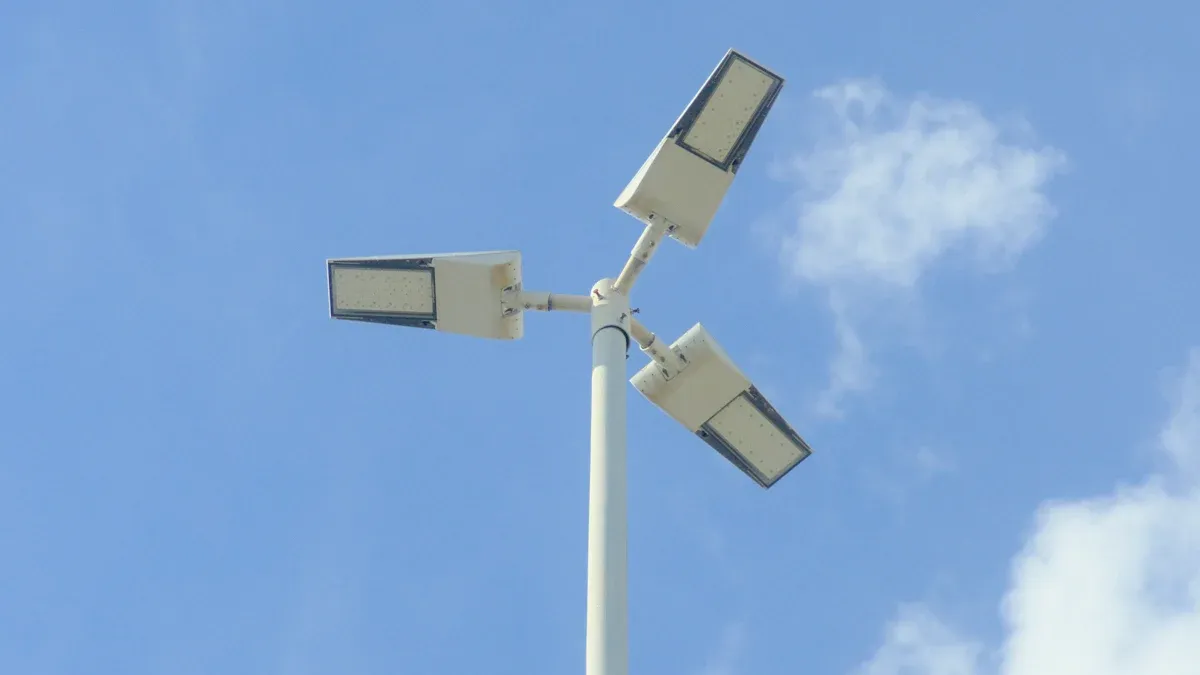
Commercial-grade solar lights are built for large-scale applications, such as parking lots, highways, and industrial facilities. These lights feature advanced solar panels, high-capacity batteries, and robust construction to ensure long-term performance. They provide powerful illumination and can operate for multiple nights without sunlight. Commercial-grade solar lights often include smart technology, such as remote monitoring and programmable settings, to optimize energy usage and maintenance.
Key Factors to Consider When Choosing Solar Lights
Energy Efficiency and Solar Panel Quality
The energy efficiency of a solar light depends heavily on the quality of its solar panels. High-quality panels convert sunlight into electricity more effectively, ensuring optimal performance even in low-light conditions. These panels generate more electricity in less time, which is essential for consistent illumination. Additionally, durable panels reduce maintenance needs and extend the lifespan of the lights. Investing in solar lights with efficient panels ensures reliable operation and long-term savings.
Durability and Weather Resistance
Durability is a critical factor for outdoor solar lights, as they must withstand various weather conditions. High-quality materials and designs enhance their resilience. For example:
| Material/Design | Contribution to Durability and Weather Resistance |
|---|---|
| Corrosion-resistant materials | Use of aluminum and stainless steel to resist moisture and environmental factors. |
| Impact-resistant materials | Use of polycarbonate and acrylic to withstand damage from impacts. |
| Advanced battery technology | Lithium-ion batteries offer longer lifespan and temperature resistance. |
| Smart control systems | Monitors operation to prolong battery life and detect issues early. |
| Modular designs | Allows for easy replacement of components, reducing maintenance costs. |
Additionally, lights with an IP65 rating or higher provide excellent protection against rain, snow, and dust, ensuring reliable performance in harsh environments.
Brightness and Light Coverage
Several factors influence the brightness and coverage of solar lights:
Solar Panel Efficiency: Efficient panels convert more sunlight into electricity, enhancing brightness.
Battery Capacity: Larger batteries store more energy, enabling brighter illumination.
LED Quality: High-quality LEDs produce brighter light with less energy.
Angle of Emission: Proper lens design improves light distribution.
Location to Install Solar Lights: Strategic placement maximizes sunlight absorption and illumination.
Choosing solar lights with these features ensures optimal brightness and coverage for any application.
Cost and Maintenance
While solar lights may have a higher upfront cost, their low operational expenses make them cost-effective in the long run. Models with durable materials and advanced technology require minimal maintenance, reducing overall costs. Modular designs also allow for easy component replacement, further lowering maintenance expenses. Selecting high-quality solar lights ensures a balance between initial investment and long-term savings.
Residential vs. Commercial Solar Lights

Design and Build Quality
Residential and commercial solar lights differ significantly in design and construction. Residential models prioritize aesthetics and affordability. They often feature smaller, decorative designs suitable for gardens or pathways. In contrast, commercial solar lights are engineered for functionality and durability. These systems include high-quality components, such as advanced solar panels and robust materials, to ensure optimal performance in demanding environments.
| Feature | Residential Solar Lights | Commercial Solar Lights |
|---|---|---|
| Size | Smaller, decorative styles available | Larger systems designed for extensive coverage |
| Power System | Integrated solar power with small batteries | Customized solar assemblies with backup storage |
| Operation | Limited to single use, not designed for overcast weather | Designed for determined operation schedules, can power multiple fixtures |
| Installation Flexibility | Must be placed in sunny locations | Can be installed remotely from the solar panel |
Commercial-grade systems also comply with strict safety and performance standards, making them suitable for large-scale applications like parking lots or industrial facilities.
Installation and Scalability
Residential solar lights are simple to install and require minimal technical expertise. Their compact size and lightweight design make them easy to position in sunny locations. However, they are not scalable and are typically limited to single-use applications.
Commercial solar lights, on the other hand, demand professional installation due to their complexity. These systems can operate multiple fixtures from a single power source, making them ideal for large areas. Their scalability allows businesses to expand lighting coverage as needed, ensuring long-term adaptability. Additionally, commercial systems include significant backup storage, enabling reliable operation even during overcast conditions.
Performance and Longevity
Residential solar lights offer adequate performance for small-scale applications. They provide ambient lighting but may struggle in low-light conditions. Their lifespan is shorter due to smaller batteries and less durable materials.
Commercial solar lights excel in performance and longevity. They feature advanced solar panels, high-capacity batteries, and weather-resistant construction. These systems deliver consistent illumination for extended periods, even in challenging environments. Their ability to operate on determined schedules ensures reliability for critical applications, such as security or public safety.
Recommendations for Selecting the Best Solar Lights
Tips for Residential Use
Selecting the right solar light for residential use involves considering several key factors:
Solar Panel Efficiency: High-efficiency panels (15%-20%) ensure better performance, especially in areas with limited sunlight.
Battery Capacity and Type: Opt for higher-capacity batteries, such as lithium, for longer operation and durability.
Lumens and Light Output: Choose lights based on their purpose. For security, select models with 1,000 lumens or more. For ambiance, 10-30 lumens may suffice.
Build Quality and Materials: Durable materials like aluminum or steel, combined with weather-resistant ratings (e.g., IP65), ensure longevity.
Features and Functionality: Motion sensors, dusk-to-dawn sensors, and remote controls enhance convenience.
Warranty and Support: A warranty of at least one year provides peace of mind and indicates product reliability.
These considerations help homeowners achieve both functionality and aesthetic appeal in their outdoor spaces.
Tips for Commercial Use
Commercial applications demand robust and scalable solar lighting solutions. Key recommendations include:
Solar Panel Efficiency: High-efficiency panels (15%-20%) maximize energy generation.
Battery Capacity and Type: High-capacity lithium batteries ensure extended operation, even during overcast conditions.
Lumens and Light Output: Select lights with 1,000 lumens or more for security and large-scale illumination.
Build Quality and Materials: Use durable materials like aluminum or steel with weather-resistant ratings (e.g., IP65).
Features and Functionality: Advanced features like motion sensors and dusk-to-dawn settings improve usability.
Warranty and Support: A warranty of at least five years ensures reliability and long-term support.
These features make commercial-grade solar lights ideal for parking lots, industrial facilities, and public spaces.
Leveraging New Solar Light Technologies
Innovative technologies in 2025 enhance the performance and versatility of solar lights. The following table highlights some of these advancements:
| Technology | Applications |
|---|---|
| Transparent Solar Panels | - Building-Integrated Photovoltaics (BIPV): Windows and facades generating power while allowing natural light. |
| - Greenhouses: Allowing sunlight for plants while generating electricity. | |
| - Consumer Electronics: Powering devices like smartphones and e-readers. | |
| Solar Fabrics | - Wearable Technology: Charging small devices through clothing. |
| - Tents and Awnings: Powering lighting and charging ports for outdoor use. | |
| - Architecture: Generating power through integrated shading systems and canopies. |
These advancements expand the potential applications of solar lighting, making it more adaptable to diverse needs.
Residential and commercial solar lights differ in design, scalability, and performance. Residential options focus on aesthetics and affordability, while commercial-grade systems prioritize durability and functionality. Choosing the right solution requires evaluating individual needs and leveraging advancements in solar technology.
Making informed decisions about solar lighting offers numerous benefits:
Reduced carbon emissions and waste due to longer lifespans.
Significant cost savings from low maintenance and operational expenses.
Enhanced safety, livability, and economic growth in communities.
Sustainable lighting choices empower individuals to contribute to a greener future.
FAQ
What is the lifespan of solar lights in 2025?
Most solar lights last 5-10 years. Battery replacements may be needed every 2-3 years to maintain optimal performance.
Can solar lights work during cloudy days?
Yes, modern solar panels can generate electricity even in low-light conditions. However, their efficiency decreases compared to sunny days.
Are solar lights safe for outdoor use?
Solar lights designed for outdoor use include weather-resistant materials and IP ratings. These features ensure durability and safety in various environmental conditions.